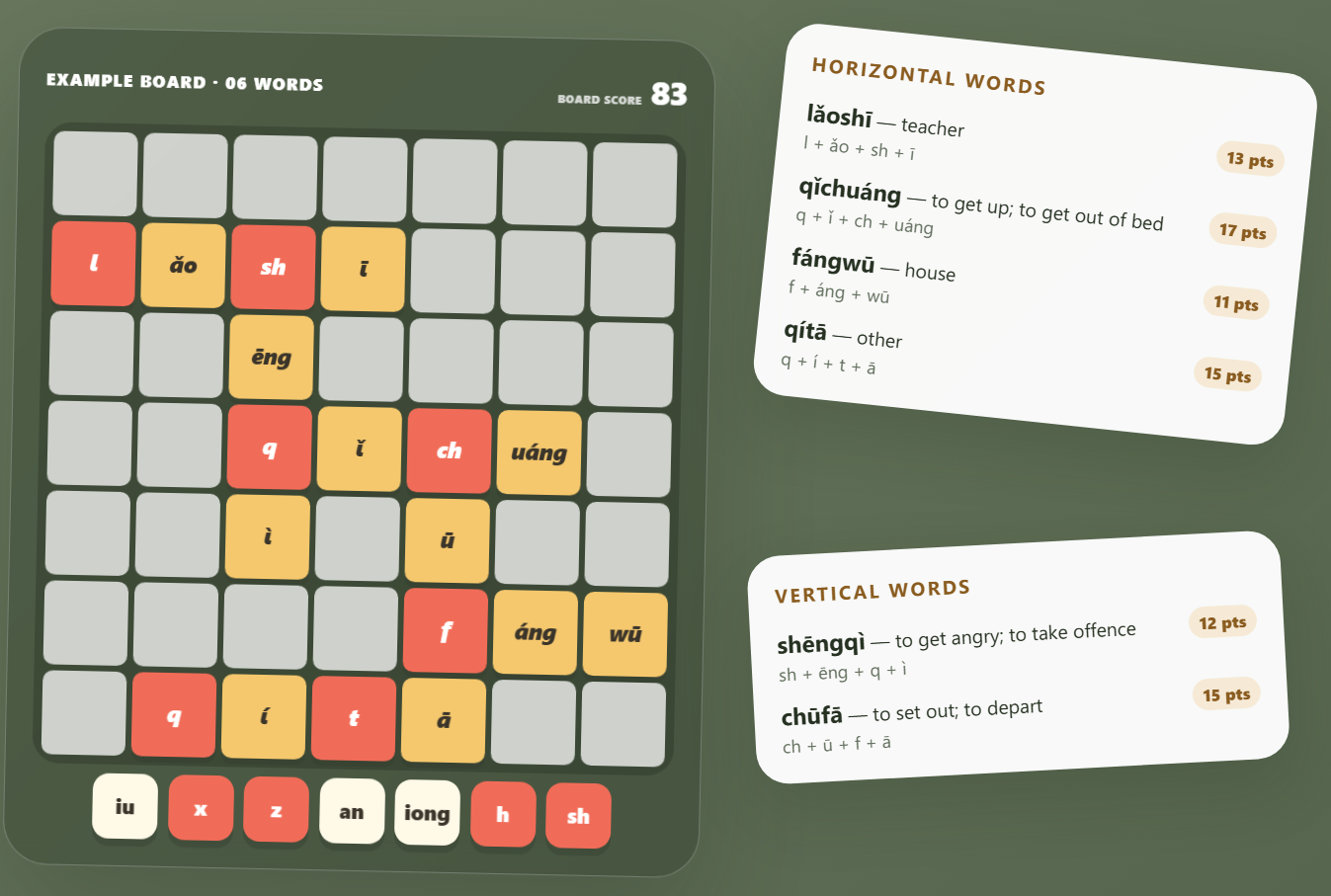
Pinyin Tiles: build connected words on a board and choose the correct tones to score points.
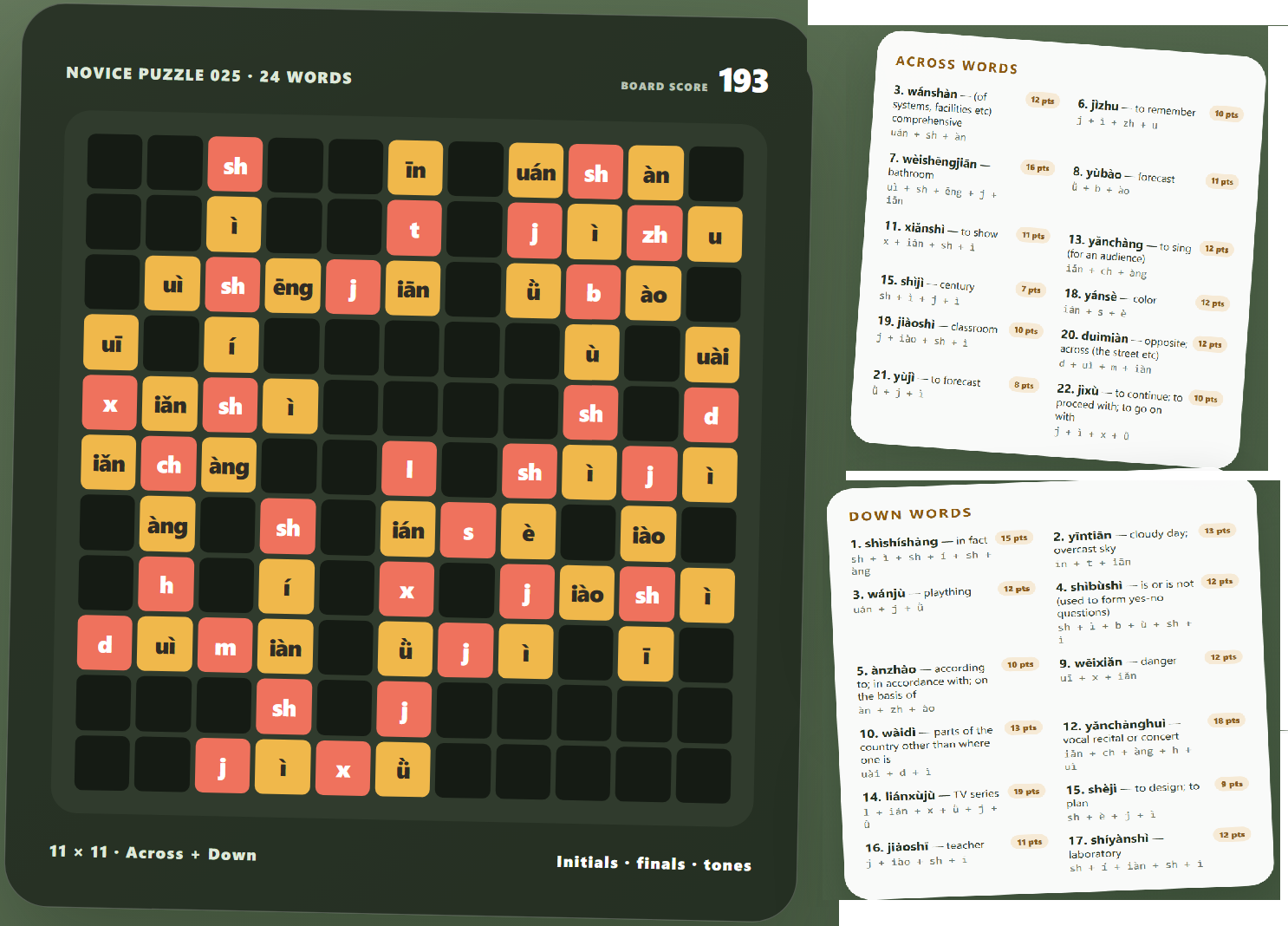
Pinyin Puzzle: use clues to complete a Pinyin crossword. Hints are switched off for this playtest.
Try one or both games, then answer the short questions that apply to each completed game. Every response helps. We are testing the games, not your Mandarin.
We hope you will try both games, but completing either one gives us useful feedback. We are testing whether the ending of each game feels clear. We are testing the games, not your Mandarin.
How to begin
Start with Pinyin Tiles
On the next screen, leave all the options exactly as they are and press Start match. Finish the game, then answer the short questions that appear on the results screen.
1
Word-building board game
Pinyin Tiles
Build Mandarin words from Pinyin sound pieces, choose their tones and reveal possible English meanings. Complete one game, then answer the short survey on its results screen.
Then, if you can: Game 2, Pinyin Puzzle (about 15 min)
Use the clues to complete words across and down. Choose the correct tones to match each word’s meaning, then answer the short survey on the results screen.
Mandarin is a language. Pinyin—or Hànyǔ Pīnyīn—is an alphabetic system used to write the pronunciation of Mandarin with Latin letters.
Pinyin is broadly phonemic: its letters and letter combinations represent the component sounds of a spoken syllable. A Mandarin syllable can usually be analysed as:
optional initial+final+tone
For example, in mǎ, m is the initial, a is the final, and the caron (ˇ) marks the third tone.
Pinyin is not a syllabary. In a syllabary, one symbol represents an entire syllable. Pinyin instead spells syllables using letters and letter combinations.
Meet the games
Three ways to play with Mandarin sound and meaning
Word-building board game
Pinyin Tiles
Combine Pinyin initials and finals, choose the correct tones and discover the possible meanings behind every valid play.
Build connected words from sound tiles. Alternating colours help you trace each word across and down
Pinyin crossword
Pinyin Puzzle
Complete a crossword built from Pinyin sound units, then use tones and meaning clues to distinguish Mandarin words that share the same written letters.
Use the clues to complete interlocking words across and down. Alternating colours help you trace each word across and down
Word and meaning matching game
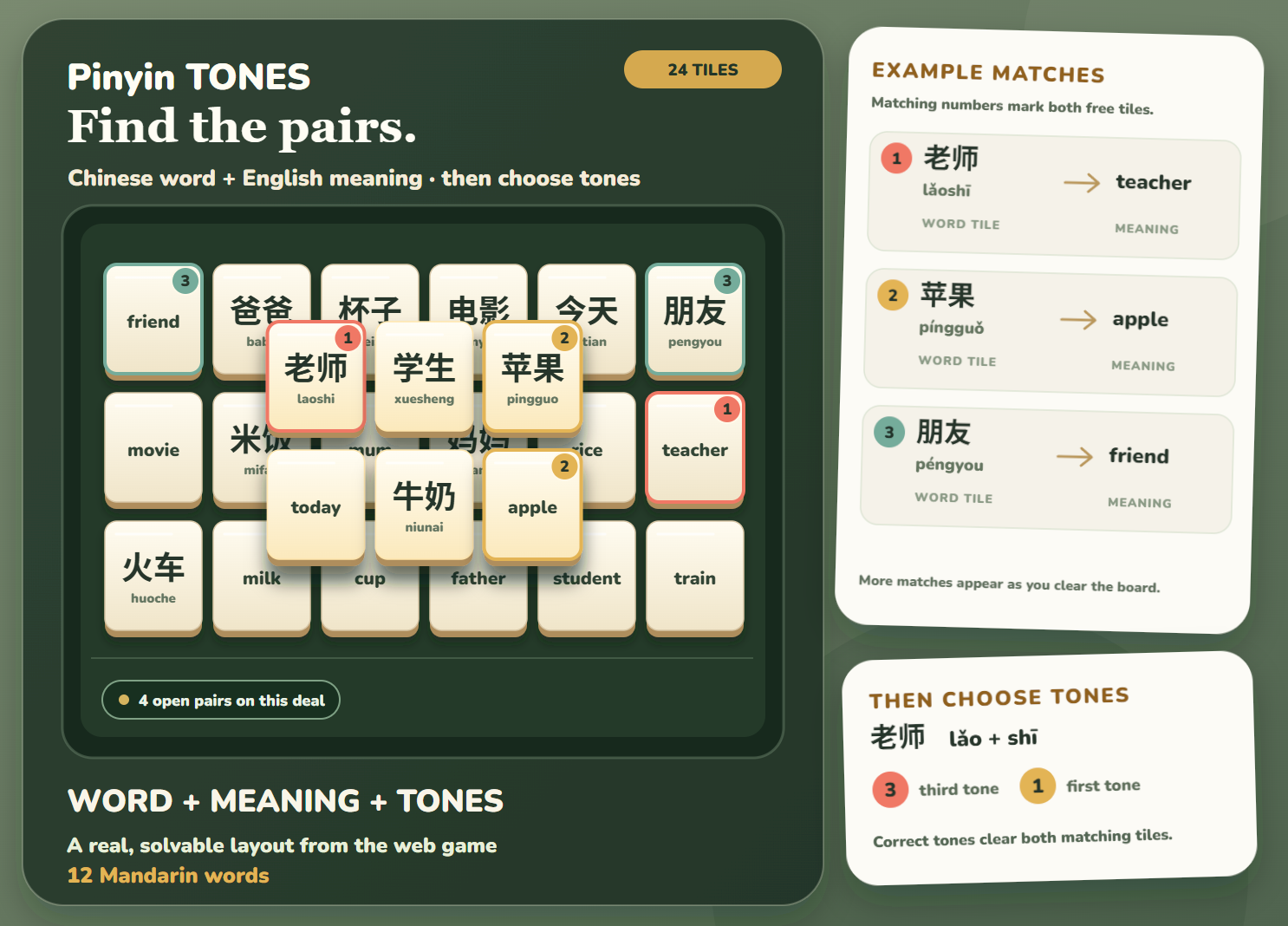
LiANN Pinyin Mahjong Tones
Find the matching Mandarin word and English meaning tiles, then choose the tones to clear the pair.
Small board · 24 tiles · three highlighted word and meaning pairs. Select the board to play Mahjong Tones. Lettering: Noto Sans SC Bold and Nunito Black (SIL Open Font License 1.1).Play Mahjong Tones
Requirements
We invite you to try both Pinyin Tiles and Pinyin Puzzle, but every completed game counts on its own. You are welcome to keep playing after the survey.
If you play both games, use the same device so we can compare your experiences; no account or personal details are required.
If you try both games, play Pinyin Tiles first, then Pinyin Puzzle. Answer up to five relevant questions after each completed game from memory.
Submit each survey on its result screen. No files need to be downloaded or returned.
What to look for while you play
Can you tell when the game is beginning to approach its end?
Does “End imminent” feel more urgent than “Approaching end”?
Can you easily understand who is ahead and why?
Do the end-of-game messages make sense without depending only on colour or movement?
Can you still see and use the whole game board when these messages appear?
Why take part
How your playtest helps
Your experience will directly shape how Pinyin Tiles and Pinyin Puzzle guide future players through the final stages of a game. We include every valid response in that game's findings. When you complete both games, we also compare your experiences. Questions about phases you did not encounter are skipped, and serious difficulties are flagged for immediate review even if only one player reports them.
01
Clearer endings
Your answers show whether players can tell when each game is nearly over—and understand why.
02
Better timing
Your sense of pace helps us tune warnings so they arrive when they are useful, not too early or too late.
03
Fairer, more accessible play
Your feedback helps us make the same endgame cues understandable without relying only on colour or animation.